Index
Electrical insulation covers, indexed by where the bare metal is
A 100 mm busbar tee, a conductor 38 mm across the strands, a crimped ring terminal in a panel: three pieces of bare metal, three different covers.
Four materials, and the metal each one is moulded around
Four materials carry this whole range. Voltage class sets the wall thickness; the material sets the temperature band, the surface behaviour and whether the part survives being taken off. The two published range sheets are Insulation Enhancement Products for the outdoor covers and switchgear insulation products for the indoor ones, and reading a cover datasheet explains what each test column is actually proving.
Flexible PVC is the moulded indoor material — Termicap terminal caps, Termicover tab covers, the Insulshroud boot and the moulded shroud. Dielectric strength is 16 kV/mm (min., ASTM D149) on the shroud and on Termicap, 12 kV/mm (min., ASTM D149) on Termicover, over a continuous operating band of −20 to +115 °C (IEC 216), with flammability passing UL 94-V0. Insulshroud is UL certified under File E335936 and is formulated against rodents and termites. Reach for PVC where the part is moulded to a shape, sits in air, and has to come off again.
Cross-linked polyolefin is the non-tracking material and the one with the fullest published sheet. On the line-cover grade: 20 kV/mm dielectric strength (min., ASTM D149), a continuous limit of −45 to +105 °C (IEC 216), volume resistivity 1 × 10¹³ ohm·cm (min., ASTM D257), tensile strength 9 N/mm² (min.) at 250 % ultimate elongation (ASTM D638), no colour change after 5,000 hours of UV (ASTM G154), and no tracking, erosion or flame failure up to 3.25 kV for 20 minutes (ASTM D2303). The moulded-shroud grade of the same polymer is quoted higher again at 22 kV/mm (min., ASTM D149) across −40 to +115 °C (IEC 216). Halogen free, flame retardant. Reach for it outdoors, and indoors wherever a damp or contaminated surface would otherwise track.
EPDM rubber appears in exactly one place in this index: the cable terminal protector, injection-moulded as a boot, grommets and a plug for indoor terminations in motor terminal boxes, ring main units and distribution transformers. It takes 25 sq.mm to 300 sq.mm cable including sector-shaped cable, is described as economically viable at 11 kV and 22 kV, and the GTPE-500 elbow version exceeds 15 kV/mm. The manufacturer states plainly that GTPE-500 is not a touch-proof product, and that sentence is worth more than the rest of its datasheet.
Silicone rubber is the outdoor field-fit material: non-tracking, highly flexible, and the only one whose sheet states that the cover does not require further derating of the conductor. GSOC self-locking covers go on with no special tool, GSIOC interlocking covers reach 33 kV, and a self-fusing silicone tape 63.5 mm × 0.76 mm can be wrapped over the cover where more insulation is wanted. A modified silicone/rubber compound is also what makes the reusable insulating boot pliable enough to be pulled off a 46 to 70 mm bushing and pushed back on.
Six families, sorted by what is exposed
A card here is navigation, not a product. Each one lands on the page that carries the sizes, the wall thicknesses and the removal method for that family.
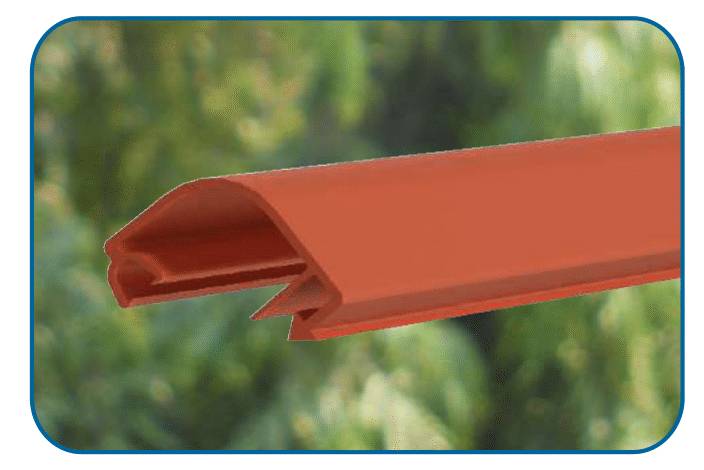
Overhead line covers
Bare distribution and transmission conductor, plus the jumpers and leads at a crossarm. Wrap-around polyolefin and self-locking silicone, both sized on conductor diameter.
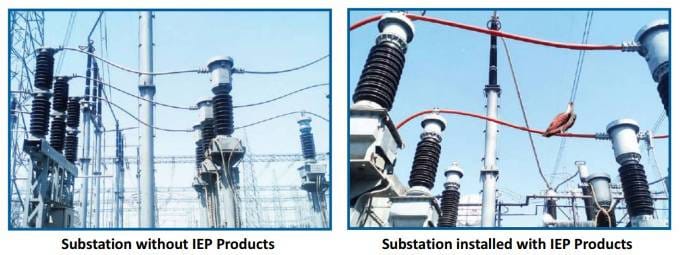
Insulator and bushing cover-ups
GPFIC covers for breaker bushings, bus standoff insulators, capacitors, transformer bushings, voltage regulators and potential transformers. Trimmed at the holes on site, re-entered years later.
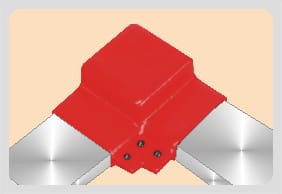
Insulating shrouds
The moulded cover that goes over an already-assembled connection and comes back off with its own fasteners. Wall thickness is set by voltage class, not by the shape of the joint.
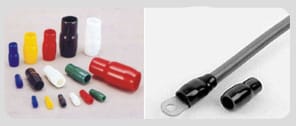
Terminal caps and covers
Termicap over a crimped ring terminal, Termicover over a flat or straight tab. Both moulded in flexible PVC, both push-on, both colour-coding as a second job.
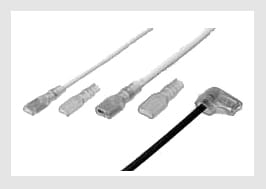
Shrouding a panel or terminal box
Walking an assembled panel or a transformer terminal box and deciding what gets covered, in what order, and what has to stay reachable for the next inspection.
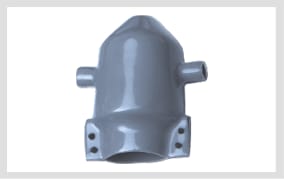
Wildlife protection covers
Raptors, squirrels and racoons bridging a clearance, plus vegetation and airborne debris. Which asset takes which cover, and where a repeat outage record usually points first.
The voltage ladder, indoors and out
- 3.3 kV, indoors
- The thinnest published shroud wall in the range: 1.25 mm of moulded PVC over an assembled connection.
- 12 kV, indoors
- 2.00 mm of PVC, or 1.0 mm of cross-linked polyolefin for the same class — the polyolefin grade carries the higher dielectric strength, so it does the job in half the wall. The EPDM cable terminal protector is quoted as economically viable at this class.
- 18 kV, indoors
- 2.50 mm of PVC, 1.40 mm of cross-linked polyolefin.
- 24 kV, indoors
- 3.00 mm of PVC, 1.80 mm of cross-linked polyolefin. It is also where the screened separable connector tops out at 630 A.
- 36 kV, indoors
- 2.50 mm of cross-linked polyolefin, or 4.50 mm of PVC quoted at 38 kV. Termicap TCV caps, Termicover GTIC covers and the moulded shroud are all tested to ANSI C37.20.2 for medium-voltage switchgear at this class, and the reusable insulating boot withstands 36 kV for one minute AC. Nothing indoors in this index goes above it.
- 12 kV, outdoors
- GSOC-M self-locking silicone, 2.0 mm wall, GSOC-M 15 through GSOC-M 38, covering conductors up to 800 sq.mm or 38 mm in diameter.
- 33 kV, outdoors
- GSIOC interlocking silicone, field-installed over a bare conductor for phase-to-phase and phase-to-ground insulation.
- 36 kV, outdoors
- GSOC-H and GSOC-H3, the same self-locking silicone construction at a heavier section.
- 66 kV — or 400 kV — outdoors
- The wrap-around polyolefin line cover, and the one rung where the manufacturer's own pages disagree with each other. The Insulation Enhancement Products page says Insulcover is used in applications up to 66 kV; the Polyolefin Overhead Line Cover page says it enhances insulation up to 400 kV. Both figures are published. Establish which one the sheet you were sent carries before you write either into a specification.
- 765 kV, outdoors
- GSOC-EH, the top of the silicone range and the highest class anything indexed on this page reaches.
The location index
Five parts are deliberately missing, because each is held by a property that carries its source document. Busbar sleeving and the BUSCAP end cap that closes a live bar end are indexed at busbarsleeves.com. GBBS barrier board and the heat-shrinkable bus sheet sit on that same property, at its barrier board page. Bushing boots for switchgear and transformer bushings are filed with the termination hardware at 66kvcabletermination.com. Shrouds and seals where a cable enters a gland are at anodecap.com. Pole caps live on that same site, and the ground-line pole sleeve is at heatshrink-sleeve.com.
| What is bare | What goes over it | Does it come off again? |
|---|---|---|
| Bare overhead conductor, 15 to 38 mm across | Wrap-around polyolefin line cover, or GSOC silicone | Silicone unlocks; the polyolefin cover is a one-time fit needing the Split Insulation Tube Tool |
| A jumper or a lead at a crossarm | GSOC silicone line cover | Yes — self-locking, no tool up the pole |
| Bus connection between two bars | GPFIC bus connection cover | Yes — trimmed at the entry and exit holes, then re-entered and reused |
| Bus standoff insulator | GPFIC cover sized to the insulator | Yes |
| Circuit breaker bushing | GPFIC bushing connection cover | Yes |
| Transformer bushing | GPFIC cover, or an Insulshroud moulded boot | Yes |
| Voltage regulator or potential transformer | GPFIC cover | Yes |
| Capacitor terminal | GPFIC cover | Yes |
| Surge arrester, auto recloser or single-pin insulator | Insulshroud PVC boot, supplied complete with fasteners | Yes — installs, removes or replaces |
| An assembled connection inside a panel | Moulded insulating shroud, PVC or cross-linked polyolefin | Yes — minutes, with its fasteners |
| A draw-out circuit breaker | Insulation boot for circuit breaker, non-tracking cross-linked polyolefin | Yes — as often as required |
| A crimped ring terminal on power cable | Termicap TCV cap, moulded flexible PVC | Yes — push-on, and colour-coded |
| A flat or straight tab terminal | Termicover GTIC cover, recessed on the tab shoulders | Yes — push-on, with a sleeve that keeps dust out of the cable end |
| A cable end in a tight indoor entry box | Cable terminal protector — EPDM boot, grommets and plug | Yes — re-usable, and it permits direct voltage testing in place |
What this index does not cover
Everything above is electrical insulation: the part exists so a flashover cannot start. If you arrived looking for a removable thermal insulation jacket for a pipe, a valve, a wellhead or a drum, that is a different product from a different industry and nothing indexed here is built for heat retention. Second boundary, and the more important one: no cover on this page is a substitute for isolation. A covered conductor, a shrouded connection and a capped terminal are all still live, and reducing the required air clearance around a connection does not make the metal under the cover safe to touch.
Where this index sends you next
Four of these decide between parts. The other two decide whether the part you already have is the one that failed.
- Shroud, boot, cover-up, cap or guardthe five words, and which physical part each one actually names
- Cable shroud and wire insulation covertwo phrases, four different parts hiding behind them
- Reading a cover datasheetwhat each ASTM, IEC and ANSI column on the sheet proves
- Fitting covers, shrouds and capsfour procedures, and the one removal
- Why covers failtracking, UV, thermal cycling, and the test each one predicts
- Covered conductor against a retrofit coverthe distinction that decides whether you are buying cable or buying covers
Not sure which row you are on?
Four facts pin a part down: the bar section or the conductor diameter in millimetres, the voltage class, indoors or outdoors, and whether the cover has to come off again for inspection. Send those and the cover code comes back without a second round of questions.