Application
Wildlife protection covers for distribution and substation assets
Five points of bare metal on one distribution structure — a conductor 38 mm across the strands, a transformer bushing, a single-pin insulator, a recloser terminal, a stud inside a cable entry box — and a differently shaped moulded part for each.
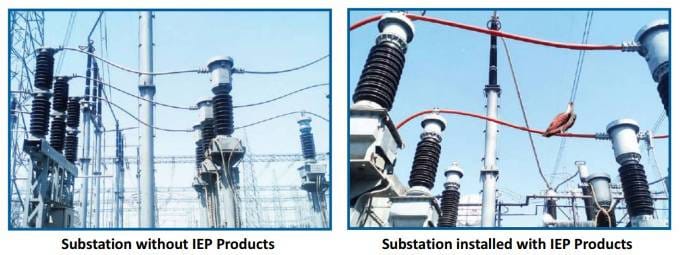
The insulation never failed. The air did.
An animal does not break through anything. It stands on one thing and reaches another, and for the instant it spans the two it is the conductor across a gap the designer left as air — phase to phase, or phase to earthed steel. Nothing on the asset was faulty before the contact and nothing is faulty after it, which is why the maintenance record so often reads no defect found. The defect was the geometry all along.
The manufacturer states the mechanism in the same terms on both of its insulation-enhancement overviews: birds, animals, vegetation and airborne debris bridge phase-to-phase or phase-to-earth clearances on bare busbars, conductors and connections, and the resulting flashover damages equipment, reduces reliability and in some cases electrocutes a protected species. Read the order of that list. The animal is third.
That order is also the commercial argument. A utility does not raise a work order because a kite died on a jumper; it raises one because the feeder tripped and a few thousand connections went dark for the reclose interval. The bird is the cause and the outage is the reported cost, so the mitigation gets judged on trip counts against a structure rather than on carcasses under it. The useful consequence is that the fix is geometric, not total: cover the metal an animal can touch while it is also touching something else, and leave the rest of the asset alone.
One structure, five gaps, and the part that closes each
Walk it downward from the conductor. Each card is a gap, not a product family — the same moulded shroud answers two of them and a different construction answers the other three. The pole crown is deliberately absent: a pole cap closes the top of the pole against water and rot rather than closing a gap between two conductors, and it belongs to anodecap.com, a sister reference run by the same publisher as this one.
The span and the jumper loops
The longest run of bare metal on the structure, and the one a wingspan crosses. Insulcover wraps the conductor in non-tracking cross-linked polyolefin, five sizes from GOC 1 at 10 mm diameter up to GOC 4, which takes 38 mm and 800 sq.mm. GSOC is the silicone alternative, self-locking and hand-fitted, in an M class to 12 kV, H and H3 to 36 kV and an EH class to 765 kV. Both are selected on conductor diameter, so what sizes the order is the number of metres either side of the structure an animal can actually reach.
The transformer or breaker bushing
At a bushing the earthed tank and the live terminal are both inside one perch's reach, which is why this gap produces repeat events at the same asset rather than scattered ones. Two families answer it. The moulded PVC Insulshroud lists bushing covers on transformers and connector covers in substations among its published uses. The GPFIC preformed polyolefin covers are drawn as shapes for breaker bushings, transformer bushings, potential transformers, voltage regulators and capacitors; the crew opens the entry and exit holes to size on the structure, and the manufacturer states the cover can be re-entered for later maintenance and then put back on.
The standoff or single-pin insulator
A standoff or single-pin insulator lifts live metal straight above an earthed support with nothing in between, and the lead leaves it at whatever angle the structure imposed years ago. Single-pin insulators are named on the Insulshroud sheet. The preformed range answers the same point with covers that arrive with no opening moulded in at all — GPS 1165, 164 mm deep over diameters of 90 mm and 130 mm, and the undimensioned GPS 1213 — so the hole gets cut on the conductor side in the field and fits the lead that is really there, not the one on the drawing.
The auto-recloser and the surge arrester
Pole-mounted reclosers and arresters carry their terminals at the top with a short bare tail running back to the line, and that tail sits at exactly the height a large bird uses. Both asset types appear by name in the Insulshroud application list. The part is moulded to size, shape and quantity rather than picked off a diameter chart, and it arrives with its fasteners, so the crew that fits it can take it off again at the next inspection without cutting anything.
The cable entry box
Reptiles and rodents do not cross a yard, they get inside a box — through the gland plate, up the duct, behind a perished door seal. The Cable Terminal Protector is a reusable barrier of boot, grommets and plug, injection-moulded in EPDM, for indoor terminations in tight enclosures: motor terminal boxes, ring main units, distribution transformer chambers. Two of its published claims matter here — a short circuit caused by a reptile, bird or animal getting in, and flash-over in a humid HT cable entry box, are both named as events the barrier exists to stop. It takes cables from 25 sq.mm to 300 sq.mm and the sheet puts its economic case at 11 kV and 22 kV.
Excreta is the second mechanism, and nothing touches anything
A bird sitting above a high-voltage insulator can drop a circuit without touching any part of it. What descends is a conducting column of liquid, and the surface it lands on belongs to the one component on the structure whose whole job is to be a long path. The event marks nothing, and it recurs at the same insulator because the same perch is still there.
The manufacturer publishes a part specifically against it. GPS 1214 is a preformed high-voltage insulator protection cover in polyolefin, 600 mm in diameter, described on the Insulation Enhancement Products sheet as protecting high-voltage insulators from the damage caused by bird excretion; the same document lists high-voltage insulator protection from bird excretion among the range's applications. Note the geometry it implies. Every other cover on this page wraps around metal; this one is a disc that has to be wider than the thing beneath it, which is why the only dimension given for it is a diameter.
Beside it on the same sheet sits GHCE 1, a preformed wraparound creepage extender in polyolefin with outer diameters stepping 564 mm, 430 mm and 372 mm. A creepage extender lengthens the surface path rather than filling an air gap, so it answers contamination and wetting on the insulator, not an animal bridging a clearance. If the recurring fault is on the insulator surface and not between two conductors, that is the family to ask about — and it is a different conversation from every card above.
Insulshroud: reading the claims literally
This is the one part in the corpus published first and foremost against wildlife rather than against clearance, so its claims are worth taking one at a time and no further than they go.
- Flexible PVC, moulded to size, shape and quantity. The shroud is drawn around the connection rather than selected from a chart, which is what lets one family serve a recloser terminal and a bushing head that share no dimension.
- UL certified under File No. E335936. That is the same file that lists the manufacturer's Busboot and Bustube busbar products. It is a listing of the material and the part, not a wildlife qualification, and no species appears anywhere near it.
- Anti-rodent and anti-termite formulation. This is a property of the compound — what the animal cannot do to the shroud. It says nothing about what the animal does to the asset underneath, and it is not an exclusion claim.
- UV and ozone protected, the minimum for a part that spends its life on a pole in the sun rather than inside a cubicle.
- Stocked in many standard sizes in grey, red or black. No voltage class is tied to a colour anywhere on the manufacturer's page, so read the choice as visibility for the crew and the thermographer.
- Fasteners come with it. The published phrasing is that the shroud installs, removes or replaces safely and easily, and that clause is the whole reason a shroud rather than a sleeve goes onto an asset somebody has to open again.
- Custom design for any shape or connection. The manufacturer backs that with its own tooling, compounding and electrical test capability to 50 kV, which is what turns a one-off recloser shroud into a realistic ask rather than a polite refusal.
- Published applications: raptors, squirrels and racoons on the wildlife side; on the asset side, bushings, substation connectors, reclosers, arresters and single-pin insulators. The manufacturer's own Insulshroud page is the source for every claim in this list.
Does it come off again? The six parts, in the manufacturer's own words
| Part | How it is held on | What the sheet says about getting back in |
|---|---|---|
| Insulcover (GOC), wrap-around polyolefin | Sealing mastic in a moulded receptacle, closed with the Split Insulation Tube Tool | Nothing. Removal and refitting are not described anywhere on the sheet |
| GSOC silicone line cover | Self-locking along the seam; no special installation tool required | Nothing. The sheet covers installation only, including at 0 °C |
| GPFIC preformed cover (GPS series) | Entry and exit holes opened to size on the structure | Can be re-entered for other maintenance needs and then reused, which the sheet ties to lower lifetime cost |
| Insulshroud moulded PVC shroud | Supplied complete with fasteners | Installs, removes or replaces safely and easily |
| Cable Terminal Protector (EPDM) | Boot, grommets and plug assembled around the termination | Re-usable, easy to install, and it leaves direct voltage testing possible |
| GPS 1214 insulator protection cover | Not stated on the sheet | Nothing. Only the 600 mm diameter and the excretion duty are given |
Every entry is the manufacturer's own published wording, not an inference. Three of the six state re-entry outright; the two line covers do not mention it at all, and a blank column is a real gap rather than a discouraging answer. The full GPS shape range and its dimensioned drawings sit on the insulator and bushing covers page, and the codes are printed in Insulation-Enhancement-Products.pdf.
The one number nobody publishes
Every electrical property in this range carries a method beside it — dielectric strength 20 kV/mm min. (ASTM D149), no tracking, erosion or flame failure up to 3.25 kV for 20 min (ASTM D2303), continuous temperature limit −45 to +105 °C (IEC 216). Nothing in the published record puts a method beside the wildlife duty itself: no species, no wingspan, no minimum covered length, no residual exposed gap the fitted part is qualified to leave, and no test at all behind the excretion cover. These are insulation products tested as insulation, and the animal is the reason for fitting them rather than the rating. Ask the manufacturer for two figures instead: the covered length each part gives on your asset, and the bare dimension it leaves at the entry and exit holes. The second one decides your next outage and appears on no sheet.
What this does not do
Nothing on this page is a deterrent. Every part here closes a gap. None of them stops an animal landing on the crossarm, climbing the pole, walking the earth wire or nesting in the structure, and not one is published as a spike, a perch diverter, a bird net or an exclusion device — fit them and the same birds will be back on the same asset tomorrow, which is the point. Covering a gap does not change the state of the metal inside it. The conductor, the bushing stud and the recloser tail stay exactly as live as they were, approach distances are unchanged, and isolation and earthing are still the only things that make the asset workable. And a gap closed most of the way is not closed. If the cover stops short of the point where the animal can reach two things at once, the structure has a new part on it and the same clearance it had before.
Where this audit continues
- Insulator covers and bus connection cover-ups (GPFIC)The full preformed range, and how a shape gets chosen when no code matches.
- Overhead line covers for bare conductorsThe conductor half of the audit: GOC polyolefin, GSOC and GSIOC silicone.
- Insulating shrouds for switchgearThe moulded shroud itself — wall thickness by class, and how it comes off.
- Shrouding a switchgear panel or transformer terminal boxThe cable entry box, and the four other indoor points a rodent reaches.
- Covered conductor is not a line coverRead before anyone on the crew treats a covered span as an insulated one.
- Fitting covers, shrouds and capsFour procedures, one removal, and which parts need a tool up the pole.
Send the gap, not the animal
A cover is quoted from the object it goes over. Give the bushing profile or insulator diameter, the conductor size in sq.mm and across the strands, the bar section at each connection, the system voltage and the quantity of each shape. Mark which points get re-entered for thermography and which are fitted once and forgotten — that column changes the part, and it is the one nobody sends.