Terminal caps and covers
Termicap and Termicover: caps and covers for terminals and tabs
A crimped ring terminal is bare metal standing in air, and the twelve Termicap sizes that close one run from 15 mm long to 79 mm.
Two parts, and the geometry picks one
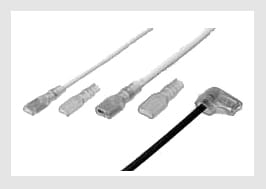
Termicap goes over a crimped ring or lug terminal: a closed, stepped body that swallows the barrel and the bared conductor behind it. Termicover goes over a straight or flat tab: an open cover with recesses moulded into the tab shoulders. Neither seats on the other's geometry, and that is the whole selection decision here.
The codes split the same way. TCV is the cap, twelve rows with five dimensions on each. GTIC is the tab cover, three codes and no chart at all.
Termicap TCV terminal cap and Termicover GTIC tab cover
Two moulded flexible-PVC parts for the cable end of a connection, both offered in custom size, shape and colour. Termicap closes a crimped ring or lug terminal, TCV 12 to TCV 3251. Termicover covers a straight or flat tab, GTIC-1 to GTIC-3, with recesses that hold the terminal firmly seated and a dust-excluding sleeve. Made in Mumbai by Gala Thermo Shrink Pvt. Ltd.
- Termicap encloses the crimp barrel and the bared conductor behind it in one moulded body
- Termicover's shoulder recesses retain it without a tie, a tape or a clip
- Colour-coded identification is a published purpose of both parts, not a by-product of moulding
| Material | Flexible PVC, moulded |
|---|---|
| Termicap range | TCV 12 to TCV 3251, twelve sizes |
| Termicover range | GTIC-1 to GTIC-3 |
| Dielectric strength | Termicap 16 kV/mm min.; Termicover 12 kV/mm min. (ASTM D149) |
| Tensile, elongation | 12 N/mm² min. at 350% min., both (ASTM D638) |
| Continuous temperature | −20 to +115 °C, both (IEC 216) |
| Switchgear test | Termicap only: ANSI C37.20.2, 36 kV class |
| Flammability | Termicover only: self-extinguishing (ASTM D876) |
| Comes off again | Yes. Push-on; no adhesive, mastic or shrink published |
Termicap selection chart
| Type | D1 (mm) | D2 (mm) | D3 (mm) | L (mm) | F (mm) |
|---|---|---|---|---|---|
| TCV 12 | 3.2 | 3.5 | 3 | 15 | 8 |
| TCV 21 | 3.5 | 4.5 | 3.8 | 18 | 10 |
| TCV 50 | 4.5 | 5.5 | 4.5 | 21 | 10 |
| TCV 53 | 5 | 6 | 5 | 25 | 10 |
| TCV 60 | 8 | 10 | 8 | 27 | 13 |
| TCV 221 | 9.5 | 12 | 8 | 30 | 16 |
| TCV 381 | 12 | 14 | 10 | 35 | 18 |
| TCV 601 | 14 | 16.5 | 14 | 42 | 23 |
| TCV 100 | 18 | 22 | 16 | 54 | 26 |
| TCV 501 | 22 | 24 | 22 | 67 | 33 |
| TCV 2501 | 26 | 37 | 26 | 79 | 38 |
| TCV 3251 | 30 | 37.5 | 30 | 78 | 38 |
From the manufacturer's Termicap sheet, whose sectioned drawing keys D3 at the closed nose, D2 across the body and D1 at the cable-entry spigot, and splits length L into B and F; B is untabulated, so it is L minus F. TCV 3251 is printed at 78 mm against TCV 2501 at 79 — wider but not longer. TCV 501 overprints the line below it in the PDF, so confirm that row before ordering. Termicap on the manufacturer's site.
Which of the three letters is the bore
The chart marks none of D1, D2 and D3 internal or external, and the drawing does not say so in words either. D2 is the largest figure in every row and is dimensioned across the body on the section, which reads as the bore. That is an inference from a drawing, not a statement from the manufacturer — so where the barrel is a close fit, get the internal diameter confirmed in writing before ordering.
Termicap measured properties
| Property | Value | Test method |
|---|---|---|
| Dielectric strength | 16 kV/mm (min.) | ASTM D149 |
| Tensile strength | 12 N/mm² (min.) | ASTM D638 |
| Elongation | 350% (min.) | ASTM D638 |
| Density | 1.23 g/cm³ | ASTM D792 |
| Hardness | 65 ± 5 Shore A | ASTM D2240 |
| Continuous operating temperature | −20 °C to +115 °C | IEC 216 |
The technical specification table on the Termicap sheet, which also carries REACH and RoHS marks. Density and hardness are on that sheet only; the manufacturer's web page for the part omits both.
Termicover, and what the recesses are for
A flat tab has shoulders where the blade steps out of the crimp, and Termicover is moulded to drop into them. That is the retention — nothing is taped, tied or clipped afterwards — and a sleeve at the other end excludes dust from the cable end.
On paper it is the weaker of the two: 12 kV/mm minimum (ASTM D149) against Termicap's 16, on the same 12 N/mm² tensile at 350% elongation (ASTM D638) and the same −20 to +115 °C band (IEC 216). It carries a self-extinguishing result to ASTM D876 that Termicap does not; Termicap carries a switchgear test that it does not.
The two records, side by side
"Not on the record" means the figure is absent from that part's page and datasheet — not that the part fails the test.
| Termicap (TCV) | Termicover (GTIC) | |
|---|---|---|
| Goes over | A crimped ring or lug terminal | A straight or flat tab |
| Published sizes | TCV 12 to TCV 3251, twelve rows | GTIC-1 to GTIC-3, three codes |
| Dimensions published | D1, D2, D3, L and F on every row | None |
| How it stays on | Not on the record | Shoulder recesses, plus a sleeve at the cable end |
| Dielectric strength (ASTM D149) | 16 kV/mm (min.) | 12 kV/mm (min.) |
| Tensile, elongation (ASTM D638) | 12 N/mm² (min.), 350% (min.) | 12 N/mm² (min.), 350% (min.) |
| Continuous temperature (IEC 216) | −20 to +115 °C | −20 to +115 °C |
| Switchgear test | ANSI C37.20.2, to 36 kV | Not on the record |
| Flammability | Not on the record | Self-extinguishing (ASTM D876) |
No GTIC dimensional chart exists to quote
Termicap gets twelve rows and five dimensions each. Termicover gets three codes and nothing else — no tab width, no thickness, no bore, no length, no drawing, on the manufacturer's page or in any datasheet searched for this page. So it cannot be ordered off a chart. Send the tab width and thickness, the free length of blade proud of the crimp, and the cable outside diameter, then ask which code matches or whether it is a custom mould. Do not order GTIC-2 because it is the middle one.
Colour identifies. It does not rate.
Custom colour is offered on both, and the manufacturer lists colour-coded identification of terminals crimped onto power cable as a purpose of the part alongside insulating it. In a panel that means phase, circuit or feeder.
No colour on either record maps to a voltage, a temperature class or a size. A red cap and a black cap of the same TCV code are the same part, so the convention has to live on the schematic — the moulding does not carry it, and a stores substitution will not flag it.
A motor terminal box is the tightest place either part goes: lugs on a stud plate inside a volume fixed by the frame size, where what bites is often not the barrel but 15 to 79 mm of cap length and the room to pull it off at the next inspection. A terminal block is where a cap stops working at all — poles sit at fixed centres and a cap adds wall thickness to every one at once, so past a certain pitch the part is a barrier between poles rather than a cover over each. That is shrouding a switchgear panel.
Two neighbouring geometries that are not these
Both get asked for in the same words and take a different part.
- A cut busbar end. Flat bar, not a terminal, and it takes a BUSCAP rather than a TCV. The same manufacturer's busbar reference publishes that chart at busbarsleeves.com.
- A whole medium-voltage termination. Once the part covers a termination rather than a crimped end it is a cable terminal protector, not a PVC cap. Those sheets are on 66kvcabletermination.com, another property published by this manufacturer.
Questions that arrive with a photograph attached
Will a Termicap fit a flat blade terminal?
Do these make the terminal safe to touch?
Can a cap come off for a thermographic scan and go back on?
What this does not do
A cap is not a seal. The only ingress claim on either part is the Termicover sleeve excluding dust from the cable end. No IP class, no gasket, no water. These are indoor parts for a dry enclosure. Flexible PVC stops at +115 °C and at −20 °C. Both records give that continuous band to IEC 216, so a terminal running hot under sustained load, or a kiosk cold-soaked below −20 °C, is outside what is published — and nothing about the part announces it. A cap is not a clearance. It covers one terminal and does nothing about the air between two of them; on a crowded stud plate the added wall thickness takes clearance away. And it is not a live-working covering. Nothing on either record permits work on or near a covered terminal that has not first been isolated and earthed.
Send the barrel, the tab and the cable
Crimp barrel diameter and the length behind it for a cap; tab width, thickness and free length for a cover; cable outside diameter for either; then the colour convention and how many per panel. That comes back as a TCV or a GTIC code rather than a question.