Overhead line covers
Wrap-around polyolefin line cover (GOC series)
The biggest conductor in the chart is 800 sq.mm and 38 mm across the strands; GOC 4 is the wrap that goes over it, 30 metres to a roll.
Insulcover polyolefin overhead line cover, GOC 1 to GOC 4
A wrap-around cover in non-tracking cross-linked polyolefin, pushed over a bare overhead conductor to retrofit insulation onto it without replacing the conductor or adding line hardware. It is fitted with the Split Insulation Tube Tool, and that tool stays in one location while the wrap feeds through it. A crew up the pole without the tool cannot fit this product at all; the self-locking silicone cover is the one that goes on by hand.
- Retrofits onto a bare conductor with no conductor replacement and no added line hardware
- UV stabilised and weather resistant; 5,000 hours with no colour change (ASTM G154)
- Tracking and erosion resistant to 3.25 kV for 20 minutes (ASTM D2303)
- Resists chemical corrosion from strong acid, alkali and salt
- Halogen free, and flame retardant (pass, ASTM D2671)
| Material | Non-tracking cross-linked polyolefin |
|---|---|
| Sizes | GOC 1, GOC 1A, GOC 2, GOC 3, GOC 4 |
| Largest conductor | 800 sq.mm, up to 38 mm diameter (GOC 4) |
| Packaging | 30 metres per roll, every size |
| Dielectric strength | 20 kV/mm min. (ASTM D149) |
| Continuous temperature limit | −45 to +105 °C (IEC 216) |
| Installation | Split Insulation Tube Tool, stationary during the fit |
Selection chart
| Gala code | Conductor size (sq.mm) | Conductor diameter (mm) | Packaging (m/roll) |
|---|---|---|---|
| GOC 1 | ≤ 99 | Up to 10 | 30 |
| GOC 1A | Up to 185 | Up to 15 | 30 |
| GOC 2 | Up to 300 | Up to 22 | 30 |
| GOC 3 | Up to 400 | Up to 28 | 30 |
| GOC 4 | Up to 800 | Up to 38 | 30 |
Five sizes, one roll length. Reproduced from the manufacturer's Insulcover selection chart.
Order against the diameter, not the square millimetres
The sq.mm column is the one everybody reads and the one that misleads. An ACSR conductor carries a steel core inside the aluminium, so it is thicker overall than an all-aluminium conductor of the same aluminium area. Two spans described identically on a schedule can therefore land in different GOC sizes. The wrap only has to clear the diameter over the strands, so that is the figure to take off the conductor schedule or a pair of callipers before anything is raised as a requisition.
The sizes butt up against each other rather than overlap. A 12 mm conductor is above the 10 mm ceiling of GOC 1 and sits inside GOC 1A; a 24 mm conductor is past GOC 2 and belongs in GOC 3. There is no intermediate size and no adjustment in the profile to take up the difference.
Quantity is metres, not pieces. Every size ships 30 metres to a roll, so the question to answer before enquiring is how much span length needs covering either side of the structure, phase by phase. That is a different arithmetic from ordering shrouds or caps, which are counted per connection.
The fitted envelope, and the tool that puts it there
The manufacturer's cross-section drawing dimensions each size, and those numbers matter more than they look. A cover is an object added to a live span: it has an outside envelope, and that envelope eats into whatever clearance the design left to the crossarm, the pole face or the phase next to it. GOC 4 is drawn 37 mm wide and 43 mm tall over a conductor that may only be 38 mm across.
The same drawing shows how the profile closes. A hooked flange runs the length of the extrusion and snaps into a receptacle on the other edge; on the GOC 4 section the receptacle is drawn with sealing mastic in it. The Split Insulation Tube Tool is the roller head that holds the profile open while the conductor is fed in. It does not travel along the span with the crew. It is held at one location and the wrap moves through it, which is why the working position and the tension in the span are part of the method rather than an afterthought.
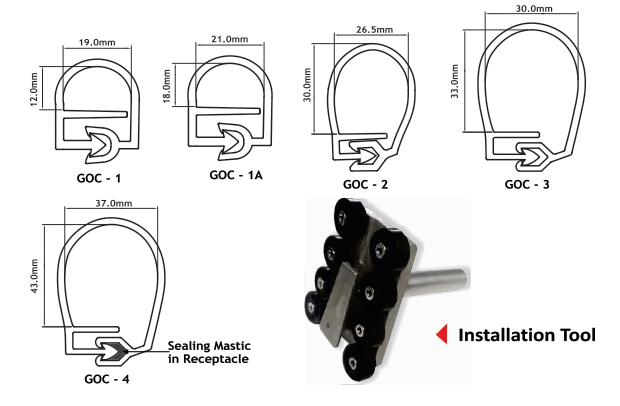
Drawn profile, by size
| Gala code | Width (mm) | Dimensioned height (mm) |
|---|---|---|
| GOC 1 | 19.0 | 12.0 |
| GOC 1A | 21.0 | 18.0 |
| GOC 2 | 26.5 | 30.0 |
| GOC 3 | 30.0 | 33.0 |
| GOC 4 | 37.0 | 43.0 |
Taken from the dimensioned cross-sections on the manufacturer's Insulcover page. Read the drawing itself before using either figure in a clearance calculation; the vertical dimension is not taken to the same feature on every size.
Measured properties, Insulcover polyolefin
| Property | Value | Test method |
|---|---|---|
| Tensile strength | 9 N/mm² (min.) | ASTM D638 |
| Ultimate elongation | 250% (min.) | ASTM D638 |
| Density | 1.20 ± 0.2 g/cm³ | ASTM D792 |
| Hardness | 40 ± 5 Shore D | ASTM D2240 |
| Water absorption | 0.5% (max.) | ASTM D570 |
| Heat shock, 90 °C for 4 hr | No cracking | ASTM D2671 |
| Flame retardant | Pass | ASTM D2671 |
| Low-temperature flexibility, −40 °C for 4 hr | No cracking | ASTM D2671 |
| Continuous temperature limit | −45 °C to +105 °C | IEC 216 |
| Dielectric strength | 20 kV/mm (min.) | ASTM D149 |
| Volume resistivity | 1 × 10¹³ Ω·cm (min.) | ASTM D257 |
| Dielectric constant | 5 (max.) | ASTM D150 |
| UV resistance, 5,000 hr | No colour change | ASTM G154 |
| Resistance to tracking and erosion | No tracking, erosion or flame failure up to 3.25 kV for 20 min | ASTM D2303 |
From the Polyolefin Overhead Line Cover sheet. These are not the figures on the busbar shroud sheets and should not be quoted for those parts.
What those durability results actually cover
Four of the rows above get quoted in tenders without much thought about what they were measuring.
- 5,000 hours with no colour change (ASTM G154) is an accelerated weathering result from a fluorescent UV chamber. It says the compound does not chalk or craze under ultraviolet; it is not a service life in years, and nobody has published one for this wrap.
- No tracking, erosion or flame failure up to 3.25 kV for 20 minutes (ASTM D2303) is the inclined-plane test, where contaminated water runs down an energised surface. That is the failure mode to worry about in coastal salt, cement dust and fertiliser drift, because on an overhead cover the surface gives way long before the wall thickness is punctured.
- Heat shock at 90 °C for 4 hours and low-temperature flexibility at −40 °C for 4 hours, both no cracking (ASTM D2671), bracket handling and service. They are short soak tests, so read them as the range the material tolerates rather than as thermal endurance.
- Water absorption 0.5% max (ASTM D570) beside volume resistivity of 1 × 10¹³ Ω·cm (ASTM D257) is the pairing that counts. The bulk resistance figure is only worth anything if the compound is not taking up moisture over a monsoon.
Insulcover against the Overhead Line Tube
| Property | Insulcover (GOC) | Overhead Line Tube | Test method |
|---|---|---|---|
| Tensile strength | 9 N/mm² (min.) | 10 N/mm² (min.) | ASTM D638 |
| Ultimate elongation | 250% (min.) | 350% (min.) | ASTM D638 |
| Hardness | 40 ± 5 Shore D | 30 ± 5 Shore D | ASTM D2240 |
| Volume resistivity | 1 × 10¹³ Ω·cm (min.) | 1 × 10¹⁴ Ω·cm (min.) | ASTM D257 |
| Accelerated ageing, 90 °C for 7 days | Not on the sheet | ±25% variation in tensile and elongation | ASTM D638 |
| UV resistance, 5,000 hr | No colour change | Not on the sheet | ASTM G154 |
Both sheets sit under the Insulcover name, and the differences below are not a transcription error — the Overhead Line Tube is a softer, stretchier compound with ten times the volume resistivity. Dielectric strength (20 kV/mm min., ASTM D149), density, water absorption, dielectric constant and the −45 to +105 °C limit are identical on both, and the tube sheet cites Technical Qualification Report 1036. Overhead Line Tube on the manufacturer's site.
400 kV or 66 kV: the manufacturer's own pages disagree
The Polyolefin Overhead Line Cover page says this construction enhances insulation up to 400 kV. Two other pages in the same catalogue, the Insulation Enhancement Products page and its shorter revision, say up to 66 kV for Insulcover and keep the 765 kV figure for the silicone GSOC cover instead. Both numbers are printed here because both are published. The figure used on this site is 66 kV: it is two sources against one, and it is the number written beside the installation description rather than in a headline sentence. If a specification turns on the higher figure, get it confirmed in writing by the manufacturer before tendering. Do not take it from a web page, this one included.
Before the requisition goes in
- Line cover size chartGOC against the silicone codes, sorted by conductor diameter
- Silicone line covers: GSOC and GSIOCThe answer when the crew has no tool, and the range above 66 kV
- Polyolefin or silicone?Where each one actually wins
- Covered conductor is a different productFactory-covered wire versus a retrofit wrap
- Fitting and removal proceduresWhat the tool does, and what comes off again
- Insulcover on the manufacturer's siteGala Thermo Shrink Pvt. Ltd., the maker of the GOC series
What this does not do
A line cover is not an insulated conductor. The wrap sits over bare metal and the conductor under it stays exactly as live as it was the day before. There is no touch-proof or touch-safe rating on this product, and nothing on the sheet permits a crew to handle a covered span. Work it live, under the same rules as before it was fitted, and earth it the same way. It is not a clearance. A cover reduces the chance that a branch, a bird or a swinging jumper turns a momentary bridge into a fault; it does not manufacture separation the design never had, and on a tight structure the 37 mm width of GOC 4 takes clearance away rather than adding it. It does not go on without the tool. There is no hand-fit method for Insulcover, no tape-and-cable-tie version, and no field workaround. And the sheet describes no way back in. Nothing published for the GOC series covers cutting it open, re-entering it or refitting it after an inspection; where re-entry is the whole point, the GPFIC bus and bushing covers are the parts the manufacturer describes as field-trimmed, re-entered and reused.
Give the diameter, and the metres
Conductor diameter over the strands, span length to be covered per phase, system voltage and destination. That is enough to come back with a GOC code and a roll count instead of a question.